

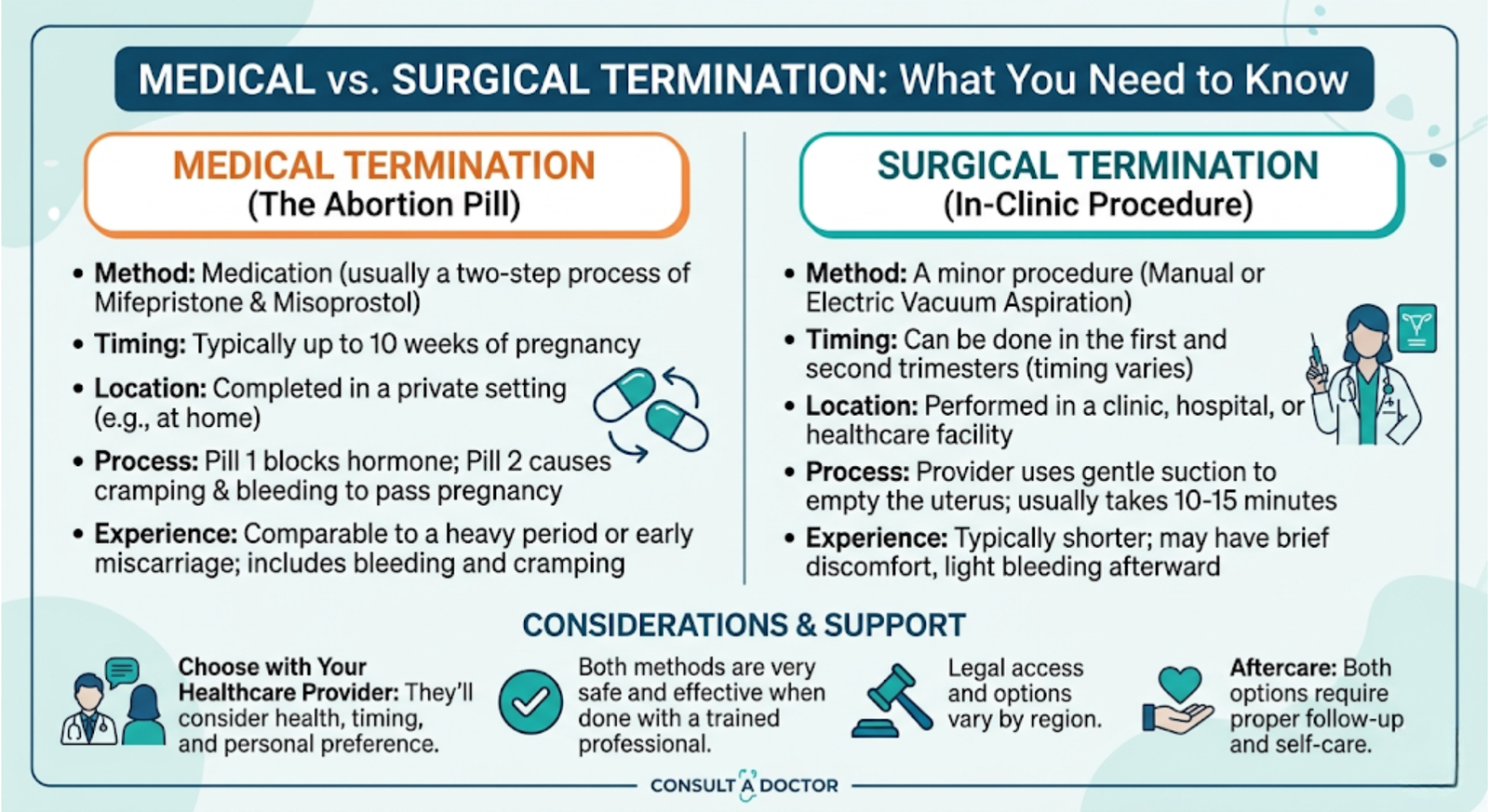
Making decisions about pregnancy termination can feel overwhelming, especially when you’re faced with medical terms and conflicting information. Understanding your options clearly—medical termination vs. surgical termination—can help you make an informed choice in consultation with a qualified healthcare professional.
This guide breaks down both methods, their differences, safety considerations, and when each may be recommended.
Understanding Pregnancy Termination
Pregnancy termination (abortion) is a medical procedure used to end a pregnancy. Depending on factors like gestational age, medical history, and personal preference, your doctor may recommend either:
- Medical termination (abortion pills)
- Surgical termination (clinical procedure)
Both methods are safe when performed under proper medical supervision.
What Is Medical Termination?
Medical termination involves using prescribed medications to end a pregnancy. It is typically recommended in the early stages (usually up to 7–9 weeks).
How It Works
Two medications are commonly used:
- Mifepristone: Blocks the hormone progesterone, stopping pregnancy growth
- Misoprostol: Causes the uterus to contract and expel the pregnancy tissue
What to Expect
- Taken under medical guidance
- Cramping and bleeding similar to (or heavier than) a period
- Follow-up consultation to ensure completion
Benefits
- Non-invasive
- Can feel more private and natural
- No anesthesia required
Limitations
- Not suitable for later stages of pregnancy
- May not be recommended for individuals with certain conditions (e.g., severe asthma, bleeding disorders)
- Requires strict medical supervision
What Is Surgical Termination?
Surgical termination is a clinical procedure performed by a trained doctor, usually recommended for later stages of pregnancy or when medical termination isn’t suitable.
Common Methods
- Vacuum aspiration (early stage)
- Dilation and evacuation (later stage)
What to Expect
- Performed in a clinic or hospital
- Usually quick (10–20 minutes)
- May involve local or general anesthesia
Benefits
- Faster completion
- Highly effective
- Less prolonged bleeding compared to medical abortion
Limitations
- Involves a medical procedure
- Requires clinic visit
- Small risk of complications (rare when done safely)
Medical vs. Surgical Termination: Key Differences
| Feature | Medical Termination | Surgical Termination |
| Method | Medications | Clinical procedure |
| Timing | Early pregnancy | Early & later stages |
| Invasiveness | Non-invasive | Minimally invasive |
| Duration | Several hours to days | Usually completed in one visit |
| Privacy | Can be done at home (with supervision) | Requires clinic visit |
Why Pre-Procedure Care Matters
Before any termination method, doctors typically recommend:
- Ultrasound scan to confirm pregnancy location and duration
- Medical history evaluation
- Blood tests (if required)
This ensures the procedure is safe and appropriate for your condition.
When Medical Termination May Not Be an Option
Medical abortion may not be suitable if:
- Pregnancy is beyond the recommended gestational age
- There is a suspected ectopic pregnancy
- Certain health conditions are present (e.g., chronic asthma, bleeding disorders)
- You cannot access emergency medical care if needed
In such cases, a doctor may recommend surgical termination instead.
Emotional and Personal Considerations
The decision to terminate a pregnancy is deeply personal. It’s important to:
- Seek non-judgmental medical advice
- Consider your physical and emotional well-being
- Take time to understand your options
You don’t have to navigate this alone—qualified professionals are there to support you.
FAQs
1. Is medical abortion safe?
Yes, medical abortion is safe when done under the guidance of a qualified healthcare provider, especially in early pregnancy.
2. How painful is a medical termination?
It typically involves cramping similar to strong menstrual pain. Pain levels vary from person to person.
3. How long does surgical abortion take?
The procedure usually takes 10–20 minutes, though you may spend a few hours at the clinic for preparation and recovery.
4. Will it affect future fertility?
When performed safely, both medical and surgical abortions generally do not affect future fertility.
5. Do I need rest after the procedure?
Yes. Rest is recommended for a few days, and you should follow your doctor’s aftercare instructions.
6. Is an ultrasound necessary before abortion?
Yes, it helps confirm the pregnancy’s location and duration, ensuring the safest method is chosen.
Both medical and surgical termination methods are safe, effective, and widely used—the right choice depends on your medical condition, pregnancy stage, and personal comfort.
If you’re considering pregnancy termination, don’t rely solely on online information. Consult a qualified gynecologist to understand what’s safest for you.
👉 Book a confidential consultation today
👉 Get expert guidance tailored to your health
👉 Make an informed, safe decision with professional support
Your health, safety, and well-being come first.