

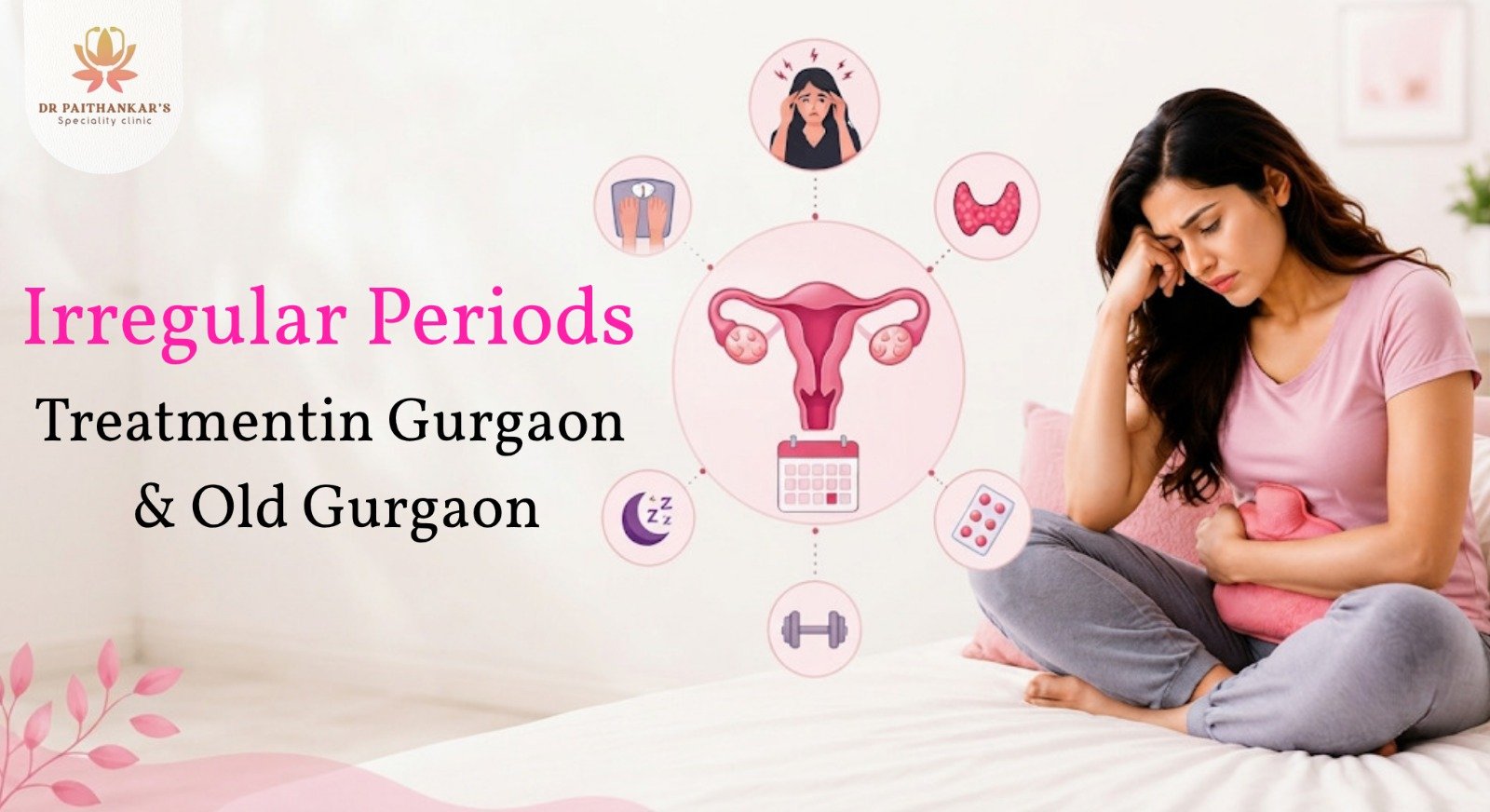
Periods can be unpredictable sometimes. Your cycle may arrive earlier than expected, get delayed for weeks, become unusually heavy, or even disappear for a month or two. While an occasional change does not always indicate a health problem, repeated irregular periods should not be ignored.
If you are looking for irregular period treatment in Gurgaon or Old Gurgaon, the first step is understanding why your periods have changed. Hormonal changes, PCOS, thyroid problems, stress, weight changes, certain medicines, pregnancy, and other health conditions can all affect the menstrual cycle.
At the clinic of Dr. Mukti Harne Paithankar, Obstetrician and Gynecologist, Infertility Specialist, and Laparoscopic Surgeon in Gurgaon and Delhi NCR, menstrual concerns can be evaluated based on your individual symptoms, health history, and reproductive goals rather than following the same approach for everyone.
What Are Irregular Periods?
Irregular periods mean that your menstrual cycle does not follow a predictable pattern or that there has been a significant change in the timing, duration, or flow of your periods.
For many adults, menstrual cycles occur approximately every 21 to 35 days, although individual patterns can vary. What matters is not necessarily having the exact same cycle every month, but noticing whether there has been a persistent or unusual change from your normal pattern.
You may notice:
- Periods arriving much earlier or later than expected
- Skipping periods for several weeks or months
- Very heavy menstrual bleeding
- Periods lasting longer than usual
- Very light or unusually short periods
- Bleeding or spotting between periods
- Sudden changes in period-related symptoms
A single unusual cycle can happen for many reasons. However, if your periods continue to be irregular, it is worth discussing the changes with a gynecologist.
Why Do Periods Become Irregular?
Your menstrual cycle is controlled by a complex interaction between the brain, ovaries, uterus, and hormones. Think of it like an orchestra: when one part gets out of rhythm, the entire cycle can change.
Here are some common reasons for irregular periods.
1. PCOS
Polycystic ovary syndrome (PCOS) is one of the conditions that can cause irregular periods. Hormonal changes associated with PCOS may affect ovulation, resulting in delayed or missed periods.
Some women may also experience:
- Acne
- Increased facial or body hair
- Weight changes
- Difficulty becoming pregnant
However, irregular periods alone do not automatically mean that you have PCOS.
2. Thyroid Problems
The thyroid gland plays an important role in several body functions, including metabolism and reproductive health.
Both an underactive thyroid and an overactive thyroid can sometimes affect menstrual patterns. If your periods have changed along with other symptoms, your doctor may consider thyroid-related testing.
3. Stress and Lifestyle Changes
Long-term stress, poor sleep, significant changes in exercise, restrictive diets, or major lifestyle changes can affect hormones involved in ovulation.
However, it is important not to assume that every delayed or missed period is simply caused by stress. Persistent irregularity should still be evaluated.
4. Weight Changes
Significant weight gain or weight loss can affect reproductive hormones and ovulation.
Very low body weight, obesity, or sudden changes in weight may sometimes contribute to irregular menstrual cycles.
5. Pregnancy
If your period is late and pregnancy is possible, taking a pregnancy test is an important first step before assuming that the change is due to hormones or another condition.
6. Perimenopause
As women approach menopause, hormonal patterns can gradually change. Periods may become less predictable, with changes in timing, duration, and flow.
7. Medicines or Other Health Conditions
Certain medicines and underlying medical conditions can also affect menstrual cycles.
This is why your gynecologist may ask about your complete medical history, medications, lifestyle, and other symptoms rather than looking at your periods alone.
When Should You See a Gynecologist?
You should consider consulting a gynecologist if irregular periods keep happening, your periods stop without an obvious reason, or your bleeding becomes unusually heavy.
It is particularly important to seek medical advice if irregular periods are accompanied by:
- Repeatedly missed periods
- Very heavy bleeding
- Severe period pain
- Bleeding between periods
- Bleeding after sex
- New facial hair or significant acne
- Unusual weight changes
- Difficulty becoming pregnant
- Dizziness, weakness, or symptoms that may suggest significant blood loss
An early evaluation can help identify possible causes instead of repeatedly waiting for the next cycle.
How Are Irregular Periods Diagnosed?
There is no single test that can explain every case of irregular periods. Diagnosis usually starts with understanding your menstrual history, symptoms, lifestyle, and overall health.
During your consultation, your gynecologist may ask questions such as:
- When did your last period start?
- How often do your periods usually occur?
- How many days does the bleeding last?
- Is the bleeding unusually heavy?
- Have you recently gained or lost weight?
- Are you experiencing acne or increased hair growth?
- Are you taking any medicines?
- Could pregnancy be a possibility?
- Are you planning to become pregnant?
Depending on your symptoms, your doctor may recommend tests such as:
- Pregnancy testing
- Blood tests
- Thyroid-related tests
- Selected hormone tests
- Pelvic ultrasound
- Other investigations when required
The exact tests depend on your symptoms and medical history. You do not necessarily need every test simply because your periods are irregular.
Irregular Periods and PCOS: Are They Always Linked?
No. Irregular periods do not always mean PCOS.
PCOS is one possible cause, but menstrual changes can happen because of thyroid problems, pregnancy, stress, weight changes, perimenopause, medicines, and several other factors.
It is easy to search online and see that irregular periods are associated with PCOS and then assume that you have the condition. However, proper diagnosis requires looking at your overall symptoms and health history.
If PCOS is diagnosed, treatment can be planned according to your individual needs. This may include managing menstrual irregularity, hormonal symptoms, metabolic health, or fertility concerns.
How Is Irregular Period Treatment Planned?
Irregular period treatment depends on the underlying cause, your symptoms, age, overall health, and whether you are planning a pregnancy.
There is no single medicine or treatment that works for everyone.
Depending on the cause, management may include:
Lifestyle Changes
If stress, sleep problems, diet, exercise, or weight changes are contributing to menstrual irregularity, improving these areas may become part of your treatment plan.
Hormonal Treatment
In some situations, hormonal medicines may be recommended to regulate menstrual cycles, manage abnormal bleeding, or address specific hormonal conditions.
These medicines should only be taken under appropriate medical guidance.
Treatment of an Underlying Condition
If irregular periods are related to PCOS, thyroid problems, or another medical condition, treating the underlying issue may help improve menstrual regularity.
Fertility-Focused Treatment
For women who are trying to conceive, irregular ovulation may sometimes make pregnancy more difficult.
In these situations, evaluation and treatment can be focused on identifying the cause of irregular ovulation and supporting the patient’s fertility goals.
The right approach is based on why your periods are irregular, rather than simply treating the symptom.
Meet the Expert: Dr. Mukti Harne Paithankar
Dr. Mukti Harne Paithankar is an obstetrician and gynecologist, infertility specialist, and laparoscopic surgeon in Gurgaon and Old Gurgaon.
She provides care for women’s gynecological concerns, including menstrual problems and fertility-related issues.
When you visit a gynecologist for irregular periods, the consultation is not simply about asking, “What medicine should I take?”
It is about understanding what has changed, identifying possible causes, deciding whether further tests are required, and creating a treatment plan based on your individual needs.
A comfortable consultation can also give you the opportunity to discuss menstrual and reproductive health concerns openly and without embarrassment.
The Treatment Path: What Can You Expect?
Every patient is different, but the general evaluation and treatment process may look like this:
| Step | What Usually Happens |
| 1. Consultation | Discuss your cycle, symptoms, lifestyle, and medical history. |
| 2. Initial Evaluation | Your doctor looks for possible causes. |
| 3. Tests if Needed | Blood tests, ultrasound, or other investigations may be suggested. |
| 4. Diagnosis | The likely underlying reason is identified. |
| 5. Personalized Plan | Treatment is planned according to your symptoms and goals. |
| 6. Follow-Up | Your response to treatment and menstrual pattern are reviewed. |
A Helpful Tip Before Your Appointment
Keep track of your periods using a calendar or period-tracking app.
Try to note:
- The first day of your period
- Number of bleeding days
- Approximate flow
- Spotting between periods
- Pain or other symptoms
- Any major changes from your usual cycle
This information can make your consultation more useful and help your doctor understand your menstrual pattern.
Frequently Asked Questions About Irregular Periods
1. Why are my periods irregular every month?
Periods can become irregular because of PCOS, thyroid problems, stress, weight changes, pregnancy, hormonal changes, or other health conditions. If irregularity continues, a gynecological evaluation can help identify the possible cause.
2. Can PCOS cause irregular periods?
Yes. PCOS can affect ovulation and may result in delayed or missed periods. However, irregular periods alone do not mean that you have PCOS. Proper evaluation is important.
3. When should I be worried about irregular periods?
You should consider seeing a doctor if irregular periods continue or are accompanied by very heavy bleeding, severe pain, repeated missed periods, unusual bleeding, or fertility concerns.
4. Can stress make my periods irregular?
Yes. Significant or prolonged stress can affect hormones involved in ovulation and may change your menstrual cycle. However, persistent irregular periods should not automatically be blamed on stress without considering other possible causes.
5. Can irregular periods affect pregnancy?
Irregular periods may sometimes make it more difficult to become pregnant if they are caused by infrequent or irregular ovulation. The effect depends on the underlying cause, which is why evaluation can be helpful for women trying to conceive.
6. What is the treatment for irregular periods?
Treatment depends on the reason your periods are irregular. Depending on the cause, management may include lifestyle changes, hormonal treatment, treatment of an underlying health condition, or fertility-focused care.
Visit Dr. Mukti Harne Paithankar for Irregular Periods Treatment in Gurgaon
If your periods have become unpredictable, unusually heavy, or keep getting delayed, you do not have to keep guessing about the reason.
A consultation with a gynecologist can help you understand what may be affecting your menstrual cycle and whether you need further evaluation or treatment.
Dr. Mukti Harne Paithankar
Obstetrician & Gynecologist | Infertility Specialist | Laparoscopic Surgeon
For appointments: 095272 26788
Clinic Address – Gurgaon
1135, Sector 17-B, Block B, IFFCO Colony, Sector 17, Gurugram, Haryana – 122015
Clinic Address – Old Gurgaon
Ground Floor, near IFFCO Chowk Metro Station, Sector 29, Gurugram, Haryana – 122022
Phone: 095272 26788