

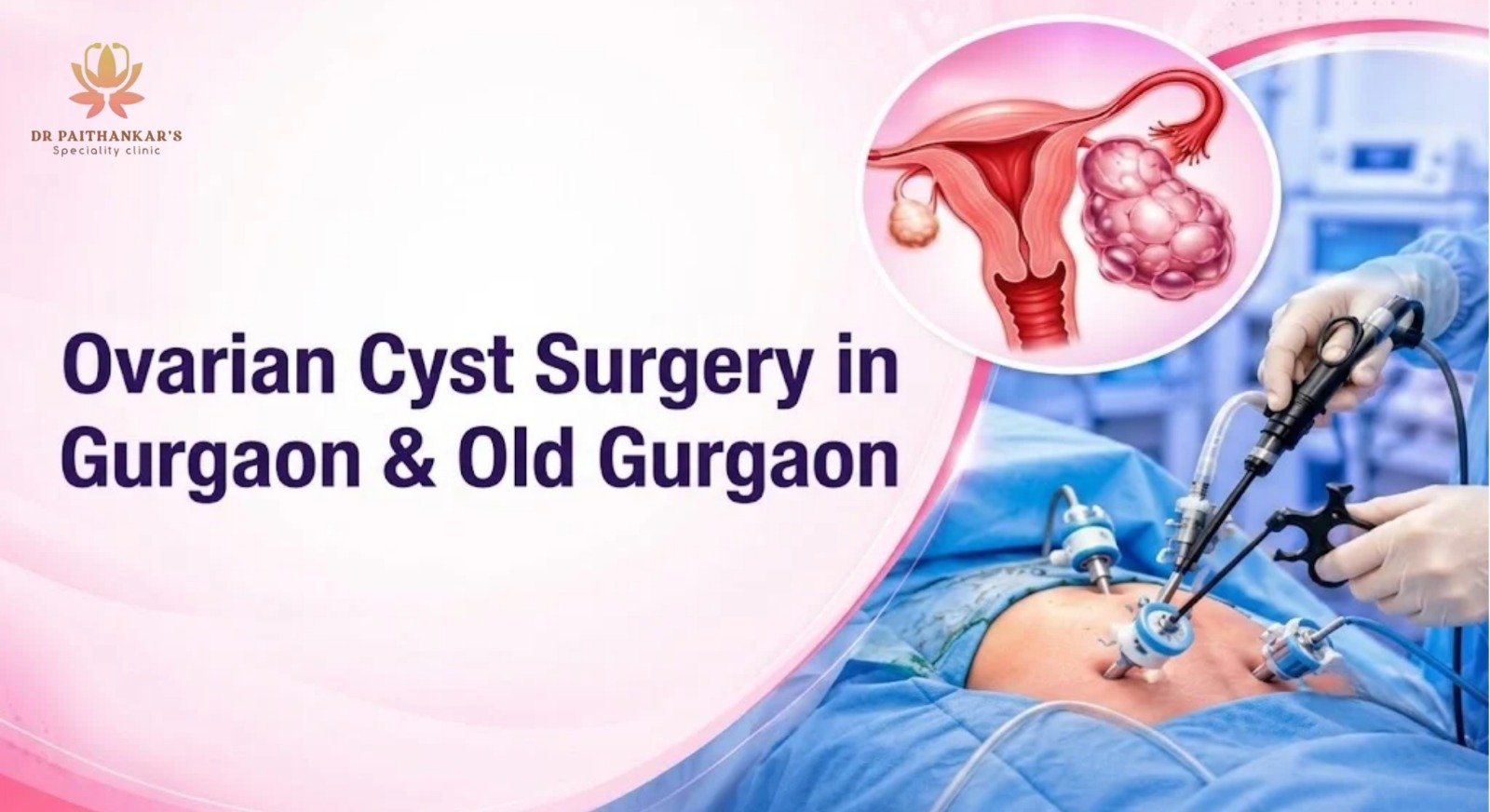
These are common concerns. The good news is that most ovarian cysts are harmless and often go away on their own without treatment. However, some cysts may grow larger, cause pain, twist the ovary, rupture, or have features that require closer evaluation.
The important thing is to understand what type of ovarian cyst you have and whether it actually needs treatment, rather than assuming that every cyst requires surgery.
If you are looking for information about ovarian cyst surgery in Gurgaon or Old Gurgaon, this guide explains the symptoms, diagnosis, treatment options, surgical procedures, fertility considerations, and recovery process.
What Is an Ovarian Cyst?
An ovarian cyst is a fluid-filled sac that develops in or on an ovary. Think of it as a small balloon that can form for different reasons.
Many ovarian cysts are associated with the normal menstrual cycle and may disappear naturally within a few weeks or months. Others may require monitoring or treatment depending on their size, appearance, symptoms, and underlying cause.
What Causes Ovarian Cysts?
There are different types of ovarian cysts, and their causes can vary.
1. Functional Cysts
Functional cysts develop as part of the normal ovulation process. They are common and usually resolve naturally without treatment.
2. Endometriosis-Related Cysts
Endometriosis occurs when tissue similar to the lining of the uterus grows outside the uterus. When this tissue affects the ovary, it can result in a cyst known as an endometrioma.
3. Pathological Cysts
These cysts develop because of abnormal cell growth. Some may be benign, while others may require further evaluation based on their appearance and other clinical findings.
What Are the Symptoms of an Ovarian Cyst?
Many women with ovarian cysts do not experience any symptoms. Cysts are sometimes discovered incidentally during a routine pelvic ultrasound.
When symptoms occur, they may feel similar to menstrual discomfort or other abdominal problems.
Common symptoms include:
- Pelvic or lower abdominal pain, sometimes on one side
- A feeling of pressure or heaviness in the abdomen
- Abdominal bloating or swelling
- Pain during sexual intercourse
- Changes in menstrual bleeding or cycle timing
- Frequent urination
- Difficulty passing stool
- Feeling full quickly while eating
- Difficulty conceiving in some cases
When Is an Ovarian Cyst an Emergency?
Sudden or severe pelvic or abdominal pain, particularly when accompanied by nausea, vomiting, fever, weakness, or dizziness, requires urgent medical evaluation.
These symptoms may occur with complications such as ovarian torsion or cyst rupture, which may require immediate treatment.
Does Every Ovarian Cyst Need Surgery?
No. Not every ovarian cyst requires surgery.
If a cyst is small, appears simple on ultrasound, and is not causing significant symptoms, your gynecologist may recommend observation and a repeat ultrasound after a suitable interval.
Surgery may be considered when:
- The cyst is large or continues to grow
- The cyst persists over time
- It causes significant or recurring pain
- Its appearance on ultrasound is concerning
- There is a complication such as torsion or rupture
- There is suspicion of a serious underlying condition
The decision is based on your individual circumstances rather than the presence of a cyst alone.
How Is an Ovarian Cyst Diagnosed?
Diagnosis usually begins with a discussion of your symptoms and medical history, followed by a physical examination when appropriate.
A pelvic ultrasound is one of the main investigations used to evaluate an ovarian cyst. It can help the gynecologist assess:
- The size of the cyst
- Its location
- Its shape
- Whether it is fluid-filled or contains solid areas
- The thickness and appearance of its walls
- Other features that may help determine the next step
Depending on the findings, your doctor may recommend additional tests or follow-up imaging.
What Does the Doctor Consider?
Treatment decisions may depend on several factors, including:
- Your symptoms
- Cyst size and appearance
- Ultrasound findings
- Your age
- Menstrual and reproductive stage
- Medical history
- Previous surgeries
- Pregnancy and fertility plans
A simple cyst may only require monitoring, while a complex or solid-looking mass may require further evaluation.
Ovarian Cyst Surgery in Gurgaon: What Happens?
When surgery is recommended, the goal is not simply to remove the cyst. Your gynecologist also considers the surrounding ovarian tissue, your symptoms, overall health, age, and future fertility plans.
Whenever appropriate, the surgeon may aim to remove the cyst while preserving as much healthy ovarian tissue as possible.
Laparoscopic Ovarian Cyst Surgery
Laparoscopic ovarian cyst surgery is a minimally invasive surgical approach commonly used when suitable for the patient and type of cyst.
Instead of making one large abdominal incision, the surgeon makes small incisions through which a camera and specialized surgical instruments are introduced.
In suitable cases, the surgeon may perform an ovarian cystectomy, which involves removing the cyst while preserving the healthy portion of the ovary.
Potential benefits of laparoscopic surgery may include:
- Smaller incisions
- Smaller scars
- Less postoperative discomfort in many patients
- Earlier mobility
- Faster recovery compared with some open procedures
However, laparoscopy is not suitable for every patient or every type of ovarian cyst. The safest surgical approach depends on the individual case.
When Is Open Ovarian Cyst Surgery Considered?
In some situations, open surgery, also called laparotomy, may be recommended.
This may be considered when the cyst is very large or when imaging and clinical findings indicate that a different surgical approach is more appropriate.
Your surgeon will discuss the recommended approach and explain why it is being considered in your particular situation.
Can Ovarian Cyst Surgery Affect Fertility?
Fertility is an important concern for many women undergoing ovarian cyst treatment.
Ovarian cyst surgery does not necessarily mean that you will lose fertility. When appropriate, surgeons may try to preserve healthy ovarian tissue while removing the cyst.
However, fertility can be influenced by several factors, including:
- The type of ovarian cyst
- Its size and location
- Whether one or both ovaries are affected
- Previous ovarian surgeries
- The amount of healthy ovarian tissue remaining
- Conditions such as endometriosis
If you are planning pregnancy, tell your gynecologist before surgery. Understanding your fertility goals can help your doctor consider the most appropriate treatment approach.
How Long Does Recovery Take After Ovarian Cyst Surgery?
Recovery varies from one patient to another. It depends on the type of surgery, your overall health, the size and nature of the cyst, and whether laparoscopic or open surgery was performed.
After laparoscopic surgery, many patients may return home the same day or after a short hospital stay, depending on their condition and the surgeon’s recommendation.
During the early recovery period, you may experience:
- Mild abdominal discomfort
- Bloating
- Tiredness
- Mild soreness around the incision sites
Your doctor may prescribe medications and provide instructions regarding wound care, physical activity, driving, lifting, work, and sexual activity.
Your recovery timeline may be different from someone else’s, so it is important to follow your surgeon’s individual instructions.
Ovarian Cyst Treatment-to-Recovery Roadmap
| Stage | What Usually Happens |
| Consultation | Your symptoms, medical history, ultrasound reports, and fertility goals are discussed. |
| Evaluation | Ultrasound and additional tests may be recommended if required. |
| Treatment Decision | Your doctor determines whether observation, follow-up, medication, or surgery is appropriate. |
| Procedure | Laparoscopic or open surgery may be performed when surgery is required. |
| Early Recovery | Rest, prescribed medicines, wound care, and gradual return to activity. |
| Follow-Up | Your recovery is reviewed and pathology results are discussed when applicable. |
Meet the Expert: Dr Mukti Harne Paithankar
Dr Mukti Harne Paithankar is an Obstetrician and Gynecologist, Infertility Specialist, and Laparoscopic Surgeon serving women across Delhi NCR and Gurgaon.
Her areas of care include women’s health, gynecological conditions, fertility-related concerns, and laparoscopic gynecological procedures.
For women diagnosed with an ovarian cyst, treatment involves more than simply looking at the ultrasound report. A detailed evaluation considers symptoms, cyst characteristics, overall health, fertility plans, treatment options, and recovery needs.
What Should You Do If You Have an Ovarian Cyst?
If you have recently been told that you have an ovarian cyst, try not to panic. The presence of a cyst does not automatically mean that you need surgery.
You can prepare for your consultation by:
- Keeping your ultrasound images and previous medical reports ready
- Making a note of your symptoms
- Tracking changes in your menstrual cycle
- Informing your doctor if you are trying to conceive
- Sharing any previous ovarian or abdominal surgeries
- Asking whether observation or treatment is recommended
- If surgery is suggested, asking why it is being recommended
- Discussing the expected recovery and follow-up process
The right treatment depends on the type of cyst and your individual circumstances.
Frequently Asked Questions About Ovarian Cyst Surgery
1. Can an ovarian cyst go away on its own?
Yes. Many functional ovarian cysts resolve naturally without surgery. Depending on the cyst’s appearance and your symptoms, your doctor may recommend observation and a follow-up ultrasound.
2. How do I know if an ovarian cyst needs surgery?
Surgery may be considered when a cyst is large, persistent, growing, causing significant symptoms, or has concerning features on imaging. The decision depends on factors such as the cyst’s characteristics, symptoms, age, overall health, and fertility plans.
3. Is ovarian cyst surgery painful?
The surgery itself is performed under anesthesia, so you will not feel the procedure. Some abdominal discomfort, bloating, or tiredness may occur during recovery and can generally be managed with prescribed medicines and appropriate postoperative care.
4. Is laparoscopic ovarian cyst surgery safe?
Laparoscopic surgery is widely used for suitable patients and can offer the advantages of smaller incisions and recovery compared with open surgery in many cases. However, whether it is appropriate depends on the type and size of the cyst and your individual health condition.
5. Will ovarian cyst surgery affect my chances of getting pregnant?
Not necessarily. In suitable cases, the cyst can be removed while preserving the ovary and as much healthy ovarian tissue as possible. However, fertility may be affected by the underlying condition, previous surgeries, or the amount of healthy ovarian tissue remaining. Discuss your pregnancy plans with your gynecologist before surgery.
6. When should I seek immediate medical help for an ovarian cyst?
Seek urgent medical attention if you experience sudden or severe pelvic or abdominal pain, particularly when it occurs with nausea, vomiting, fever, weakness, or dizziness. These symptoms may indicate a complication such as ovarian torsion or cyst rupture.
Visit Dr Mukti Harne Paithankar
Old Gurgaon Clinic – Sector 17
1135, Sector 17-B, Block B, IFFCO Colony, Sector 17, Gurugram, Haryana – 122015
Gurgaon Clinic – Sector 29
Ground Floor, Unit No. 394, Metro Station, near IFFCO Chowk, Sector 29, Gurugram, Haryana – 122022
Phone: 095272 26788